
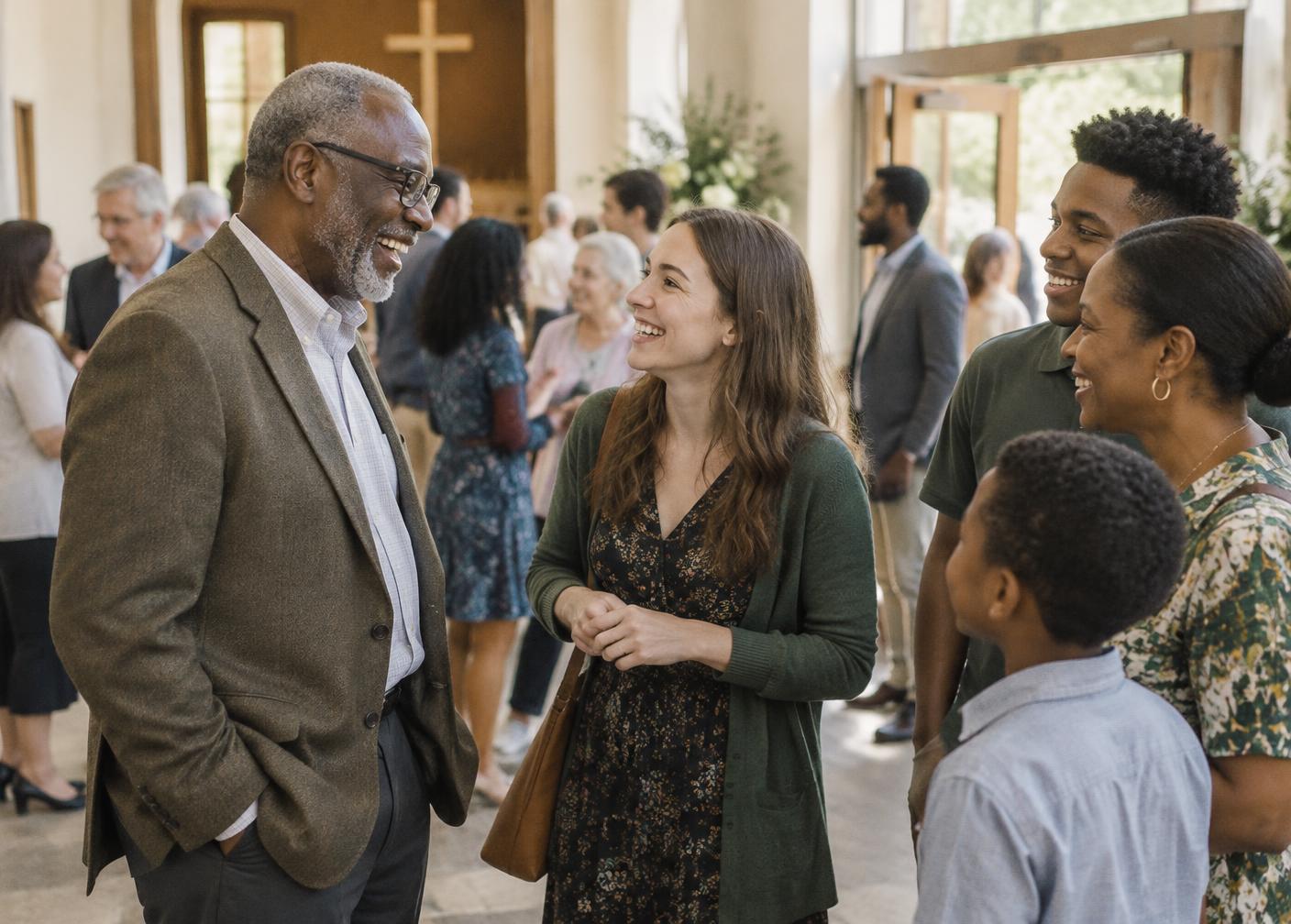
Start with places that create repeated contact
A one-time introduction can be useful, but familiarity usually grows through repetition. Places where the same people return each week or month make it easier to move from polite small talk to genuine conversation. That may be a church team, a study group, a community project, a class or a regular gathering organized for Christian singles.
Repeated contact also reduces the pressure to decide immediately whether someone is a romantic possibility. You can notice common interests, reliability and communication over time. This does not guarantee compatibility, but it gives both people more context and more freedom.
- Church small groups and service teams
- Christian professional or interest groups
- Regular volunteering with a cause you genuinely value
- Classes, choirs, sports or creative groups with recurring attendance
- Online communities with scheduled participatory rooms
Church can help—but attendance alone is not a plan
Church is an obvious place to meet people who share Christian faith, yet many adults discover that simply attending a service does not create conversation. Large congregations can feel anonymous, and some churches have few single adults in a similar life season.
Move toward the parts of church life where people work or learn together. Join a team because the work matters to you, not merely to find a date. Ask leaders whether there are inter-church events, service partnerships or groups for adults in your season. Be willing to build friendships beyond your preferred age bracket; those friendships often widen your real social world.
- Arrive early or stay for a structured after-service activity.
- Choose one ongoing role rather than attending many isolated events.
- Tell trusted friends you are open to thoughtful introductions.
- Respect the fact that worship and service are not dating marketplaces.
Volunteering reveals more than a profile
Serving alongside others can show how people communicate, solve problems and treat those who cannot offer them status. Food programs, neighborhood projects, church outreach, mentoring support and charity events are possible starting points. Choose responsible organizations with clear safeguarding and role expectations.
Do not volunteer as a disguised dating strategy. The people being served deserve genuine attention, and fellow volunteers deserve freedom from unwanted pursuit. Let connection be a possibility around the work, not the purpose of the work.
- Commit to a cause you sincerely care about.
- Observe boundaries and the organization’s conduct rules.
- Allow friendship to form before making assumptions.
Use online spaces that lead to participation
Online meeting is not limited to swiping. Look for communities organized around live discussion, faith, learning, creativity or shared life. The important question is what members actually do together. A profile directory alone gives little context; a recurring conversation or collaborative activity allows people to become familiar.
Protect personal information until trust has developed. Use platform reporting tools, keep early communication within the service where possible and make independent decisions about identity, meeting and safety. Verification steps can reduce some uncertainty but cannot establish a person’s intentions or character.
- Prefer clear moderation and community guidelines.
- Check whether private messaging requires mutual consent.
- Notice whether the space pressures rapid disclosure.
- Leave any environment that dismisses boundaries or concerns.
Turn meeting people into a sustainable rhythm
A realistic plan fits your actual week. Choose one faith-centered setting, one interest or service setting and one way to deepen existing friendships. Put recurring dates on your calendar for a season rather than judging each outing as a success or failure.
Tell a few wise people that you are open to meeting someone. Accept invitations that broaden your circle when you genuinely can. Most importantly, build a life with enough meaning that meeting a person becomes an addition, not the only evidence that your effort mattered.
- One recurring community gathering
- One activity that reflects your interests
- One friendship you intentionally strengthen
- One boundary that protects your energy and peace
Common questions
What if my church has very few single adults?
Keep your church relationships while widening your circle through inter-church gatherings, volunteering, interest groups, trusted introductions and moderated online communities.
Should I tell friends I want to meet someone?
Yes, if they are trustworthy and understand your boundaries. Be specific that you welcome thoughtful introductions, not pressure or surprise setups.
Experience Everlasting Blooms
Walk into a room with something to do
Everlasting Blooms creates online Community experiences where Christian singles can participate in conversation, worship, reflection and ordinary fun. The purpose is broader than dating: you can belong before you ever have someone to message.
Explore the Community rooms